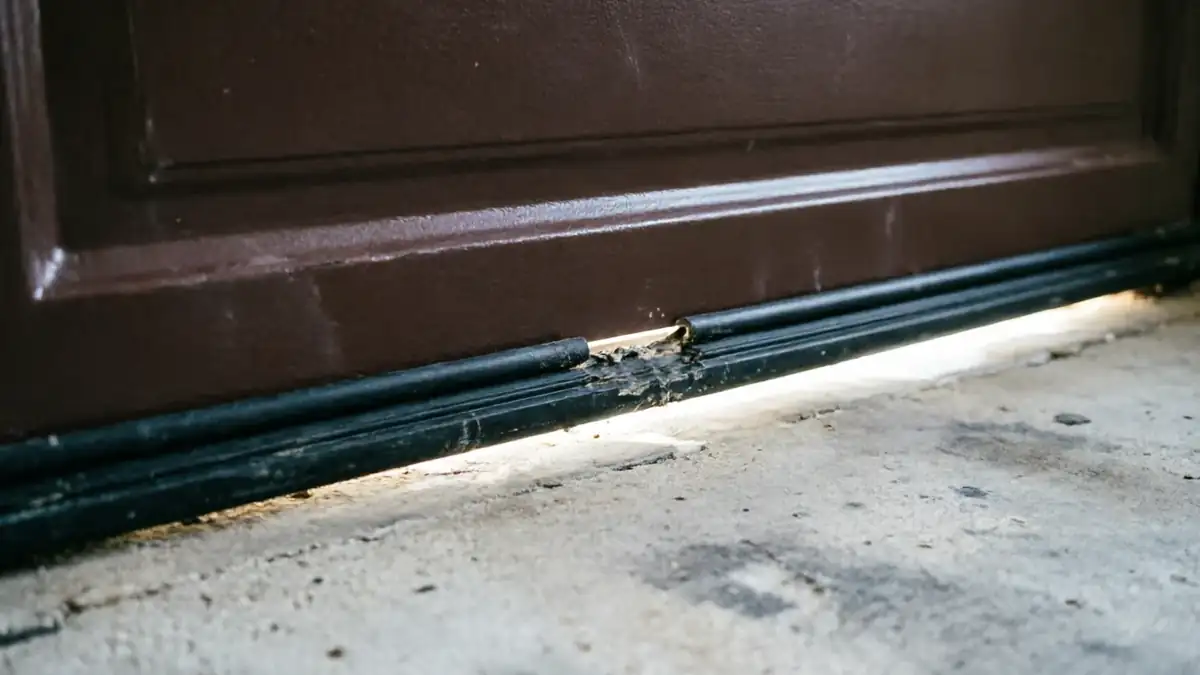
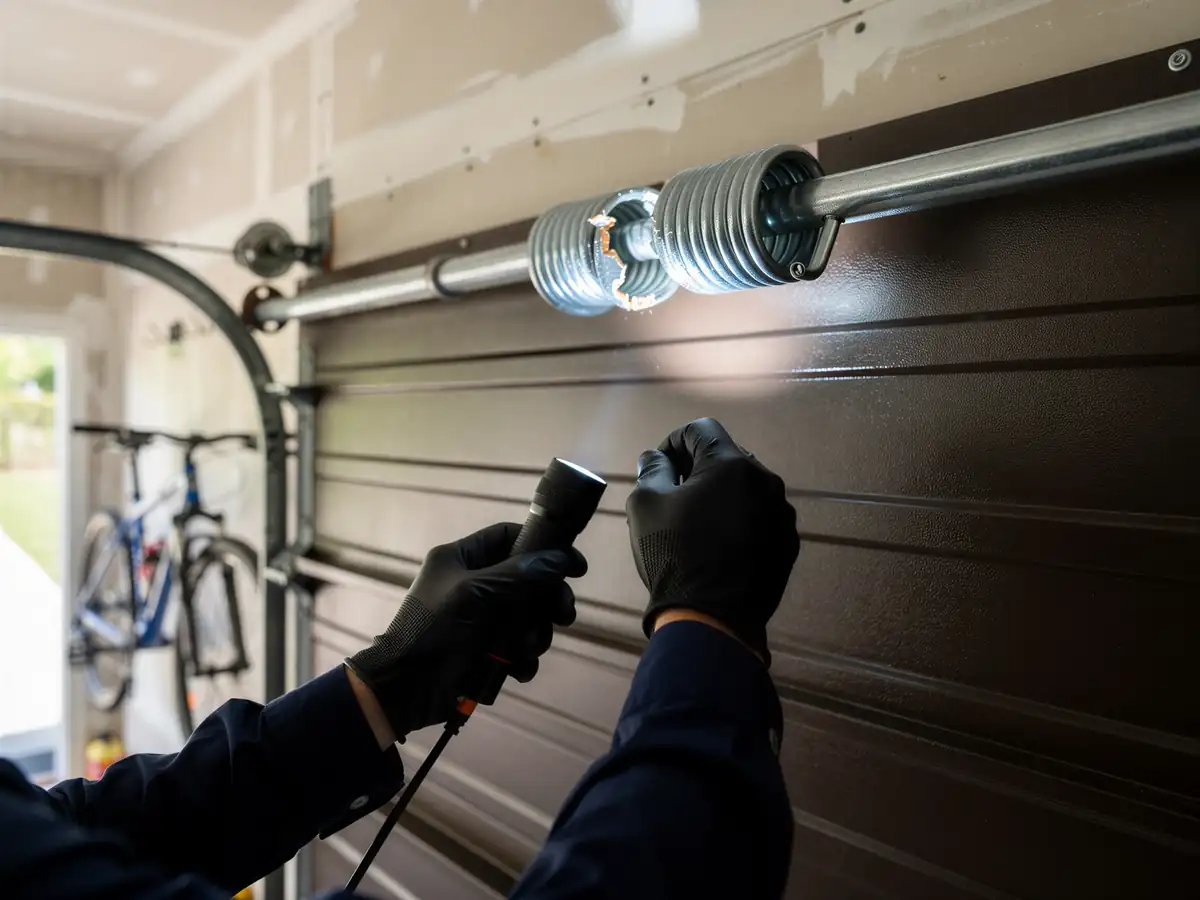
Most garage doors in this part of the valley went up between 1947 and 1987, with the median around 1964, and that's exactly the era when bottom seals and jamb weatherstripping were an afterthought, not a design feature. Across the 26 named areas that make up this service territory, the housing stock leans heavily 1960s-70s, which means the rubber astragal under the door has usually been replaced at least once, often with whatever gauge the installer had on the truck that day. A draught at the bottom corners is almost never the seal itself failing in place. It's the slab underneath it settling unevenly over sixty-some years, so the seal that was flush in 1975 now sits a quarter inch high on one side. You feel it as a line of cold air or see daylight along the bottom when the door's shut. Side seals (the vinyl strips in the track channel) wear out faster on older steel doors because the track itself has shifted slightly from decades of panel expansion and contraction. None of this is dramatic. It's just what six decades of a concrete slab and a steel door do to each other. The fix is rarely the whole door - it's almost always the seal, the astragal track, or re-shimming the bottom section so the seal actually meets the floor.
What the Weather Here Does to It
This is a mild temperate climate band, not a place with hard freezes or heavy snow load on the door. That matters because it changes what you should actually worry about. You're not fighting ice jamming a track or a seal splitting from a freeze-thaw cycle the way a door in a colder region would. What you are fighting is slow, steady wear: UV on vinyl seals, and the kind of daily temperature swing between a sunny afternoon and a cool evening that makes steel panels expand and contract just enough, year after year, to loosen screws and open gaps at the astragal. A draught here is a sign of thirty or forty years of that cycle, not a storm event. That also means you don't need the heavy-duty cold-climate seal kits sold elsewhere - a standard bottom astragal and side seal set is built for exactly this band. If someone tries to sell you an insulated weather package rated for freeze conditions, that's money spent on a problem this climate doesn't create.
When Waiting Is Fine
If the draught is a thin line of air at one bottom corner and the door still opens, closes, and seats within a quarter inch of the floor, you can live with it for a while. It's not costing you a working door, just a little comfort and maybe a slightly higher heating bill in the cooler months. Given the median household income in this service area runs well above the national figure, a lot of owners here choose to bundle a seal replacement with something else - spring service, opener work - rather than make a special trip for it. That's a reasonable call. Where it stops being fine: if the gap is uneven across the whole bottom edge, that's usually the slab or the door frame shifting, not just the seal, and a new astragal won't fix a structural gap. If you can see daylight at more than one corner, or the seal is cracked and crumbling rather than just worn thin, replace it before it lets in enough moisture to start affecting the bottom panel itself.
Where People Go Wrong
The common mistake across this area's older housing stock is treating the draught as a door problem when it's a fit problem. People replace the whole bottom seal, sometimes twice, without checking whether the slab has settled or the track has drifted out of plumb - both common in houses built in the 1960s and 70s on this kind of foundation. The seal goes back in, looks fine for a month, and the gap reappears because nothing addressed why it was uneven in the first place. The other mistake is over-correcting: cranking the opener's down-force to mash the door tighter against an uneven seal. That doesn't close the gap evenly, and it puts extra strain on the opener motor and the bottom bracket. I'll say plainly that if your slab has settled more than about half an inch across the door width, no seal product fixes that - you're looking at a track adjustment or, in bad cases, accepting the gap and focusing the seal on the parts of the opening that do close flush. That's a limitation worth knowing before you spend money on seal after seal.
Almost always uneven slab settling or a track that's drifted slightly out of plumb over the decades - common in the 1960s and 70s housing stock that makes up most of this area. The seal on the low side compresses fine; the high side leaves a gap no replacement seal alone will close.
Do I need a cold-climate weather seal kit?
No. Santa Clara sits in a mild temperate band with no hard freeze cycle, so a standard vinyl bottom astragal and side seal set, built for this climate, is enough. Insulated cold-climate kits solve a freeze problem this area doesn't have.
How often do these seals actually need replacing?
There's no fixed interval in the facts I'd trust to quote you, but UV exposure and the daily expand-contract cycle on steel doors here wear vinyl seals down steadily over years, not months. Check yours when you notice light or air at the bottom corners.
Ready to get your garage door sorted?
Tell us what it’s doing and where you are in Santa Clara - we’ll take it from there.